Photo by Aaron Cook, Maryland Forest Service
Trees across the state are starting to show some color, though early-changing leaves have been felled by the winds of the Nor’easter that hit Maryland last week.
Trees are stressed – the weather that caused crop losses at Maryland orchards this spring has also affected the trees in our forests. An unusually warm period in April prompted blooms, followed by a freeze that killed those blossoms. This prevented many trees from developing fruit, which affected their overall health.
Forester Aaron Cook explains that persistent drought, climate change, and periodic heavy rains also play a role in foliage color:
“Of the three factors that have the biggest impact on the brilliance of a foliage season – day length, temperature, and precipitation – only day length is unaffected by a warming climate. Cool nights are needed to produce the most colorful leaves, and overnight temperatures are warming faster than daytime temperatures. In Hagerstown, overnight low temperatures are 2.5 degrees Fahrenheit higher now, versus in 1950.
“Warmer fall temperatures disrupt or delay the temperature cues trees use to start going dormant. This results in a later, shorter, and often less brilliant peak fall season. Additionally, prolonged drought stresses trees, causing them to turn brown before having a chance to produce color.
“Heavy rains, which the region experienced this summer during localized severe storms, can promote the growth of fungi and diseases, which leach the nutrients a tree needs into the soil and reduces their ability to produce colorful leaves.
“Turning the calendar back to mid-April, our region had unusually warm weather. The unusual warmth caused trees to leaf out and flower earlier than usual. This was immediately followed by an unusually cold freezing event that devastated orchards and vineyards. It was also extremely hard on the forest trees, many new leaves died from the freeze, forcing the trees to flush new leaves.
“Much like the fruit we enjoy from orchards, many forest trees also produced little to no fruit due to their flowers being killed by the freeze. This is disruptive to the vigor and health of a tree and almost certainly has had an impact on fall color when considered against the warmer summer temperatures and below average rainfall the rest of the growing season.”
Western Maryland
Forester Aaron Cook, Allegany County
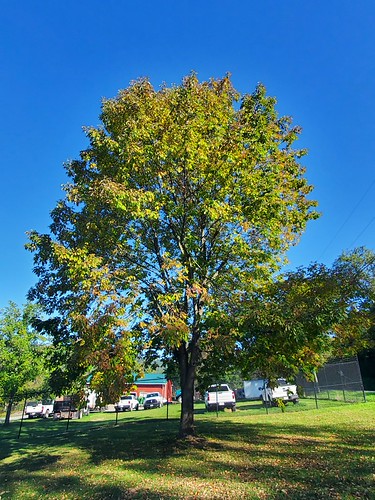
An ash tree starting to show color in Allegany County. Photo by Aaron Cook, Maryland Forest Service
Rain associated with the Nor’easter brought welcome precipitation to Washington County, along with windy conditions. The rain and wind caused some of the species showing early fall color, such as black walnut, black locust, and hackberry, to drop their leaves that had already changed.
Meanwhile a return of warmer overnight temperatures has slowed the progression of fall color. Most other trees have yet to really begin turning. The early fall season pattern of color change and leaf drop is likely to continue for another week or so before foliage begins to progress to its inevitable peak later this month.
For now, enjoy the high pressure and associated bluebird days that seem to highlight the hues of trees that have started to put on a show.
Frederick County
Forester Dakota Durcho, Gambrill State Park

Photo by Dakota Durcho, Maryland Forest Service
Most trees still remain green at this point, with the beginning of color change starting. The species that have continued to change over the past week are the blackgum, black walnut, and flowering dogwoods. Some of the juvenile ash and stressed hickory have changed early, as can be seen in the included photo. Cooler and wetter temperatures will help to push color change along over the next few weeks.
Cecil County
Ranger Lesley Leader, Fair Hill Natural Resource Management Area

Early fall rain descends on the covered bridge at Fair Hill, as leaves show a hint of the color change to come. Photo by Ranger Lesley Leader, Maryland Park Service
Dorchester County
Ranger Joanna Trojanowski, Harriet Tubman Underground Railroad State Park

A bee is well camouflaged among the goldentop wildflowers. Photo by Ranger Joanna Trojanowski, Maryland Park Service
Leaves are still mostly green in Dorchester County. Many birds are migrating through, such as swarms of tree swallows and many blue jays.
Worcester County
Pocomoke River State Park Staff
The leaves are still largely green in Worcester County, but Pocomoke River State Park is rich in mushrooms following the recent rain. The photos below were taken by Anthony Jenkins.

Photo by Anthony Jenkins

Photo by Anthony Jenkins
Happenings
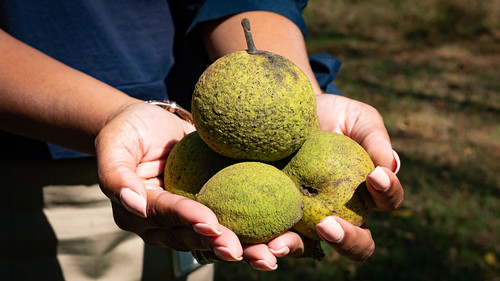
Maryland DNR photo
Fruits of the Fall
Oct. 3 at 10 a.m.
Fair Hill Natural Resources Management Area
Meet at South Appleton Lot
2000 Appleton Road, Elkton
Autumn is a time of abundance in the woods. Identify wild nuts and fruit, and learn who eats what! This is a 1.5-hour hike with medium difficulty.
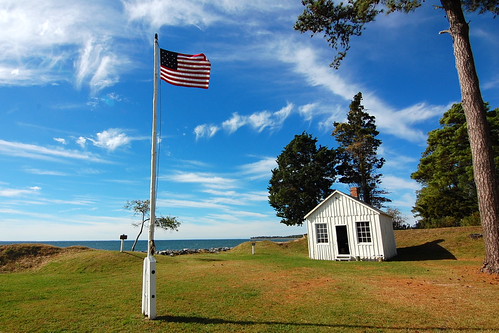
Fort No. 3 at Point Lookout. Maryland DNR photo.
Prisoner of War at Point Lookout
Oct. 3 from 9 a.m. – 4 p.m.
Oct. 4 from 9 a.m. – 3 p.m.
Point Lookout State Park
11175 Point Lookout Road, Scotland
Journey back to October 1864 when Point Lookout was an overcrowded military prison. This event from the Friends of Point Lookout will highlight the lives of prisoners, guards, and civilians who lived through it. Volunteers will present living history demonstrations and provide tours of Fort No. 3.
Oct. 17 from 7-9 p.m.
New Germany State Park
403 McAndrews Hill Road, Granstville
If you’re up for a spooky adventure, don’t miss this 1.5-mile self-guided haunted hike. Please bring a flashlight or headlamp to get to and from the trail safely. Be sure to drop by the Nature Center before or after your hike for hot cocoa, while supplies last. This event is sponsored by the Friends of New Germany. There is no fee, but donations are welcome. NOTICE: This activity will include frightening scenes, startling sounds, and walking on uneven terrain after dark. It may not be suitable for young children. Pets are not allowed.
Celestial Report
We’ll start off the month with a few conjunctions. On October 5 the moon and Mars will get together. Early in the morning around 1:30 look to the southeastern horizon. They’ll be visible until 6:30 a.m. when they’ll fade from view.
The moon and Jupiter will join up on October 6, passing within 9.5 arcminutes of each other, which is REALLY close visually. But because Jupiter is 1,800 times farther away than the moon, this “close approach” is actually an illusion of perspective. This will happen early in the morning, 2:30 – 3:00 a.m. Look east-northeast just above the horizon. With a 20% crescent moon in play it should be quite a show and the moon will actually pass right over Jupiter. If you have a telescope, Jupiter’s four largest moons, Io, Europa, Ganymeade, and Callisto, will disappear and reappear behind the dark edge of the moon.