

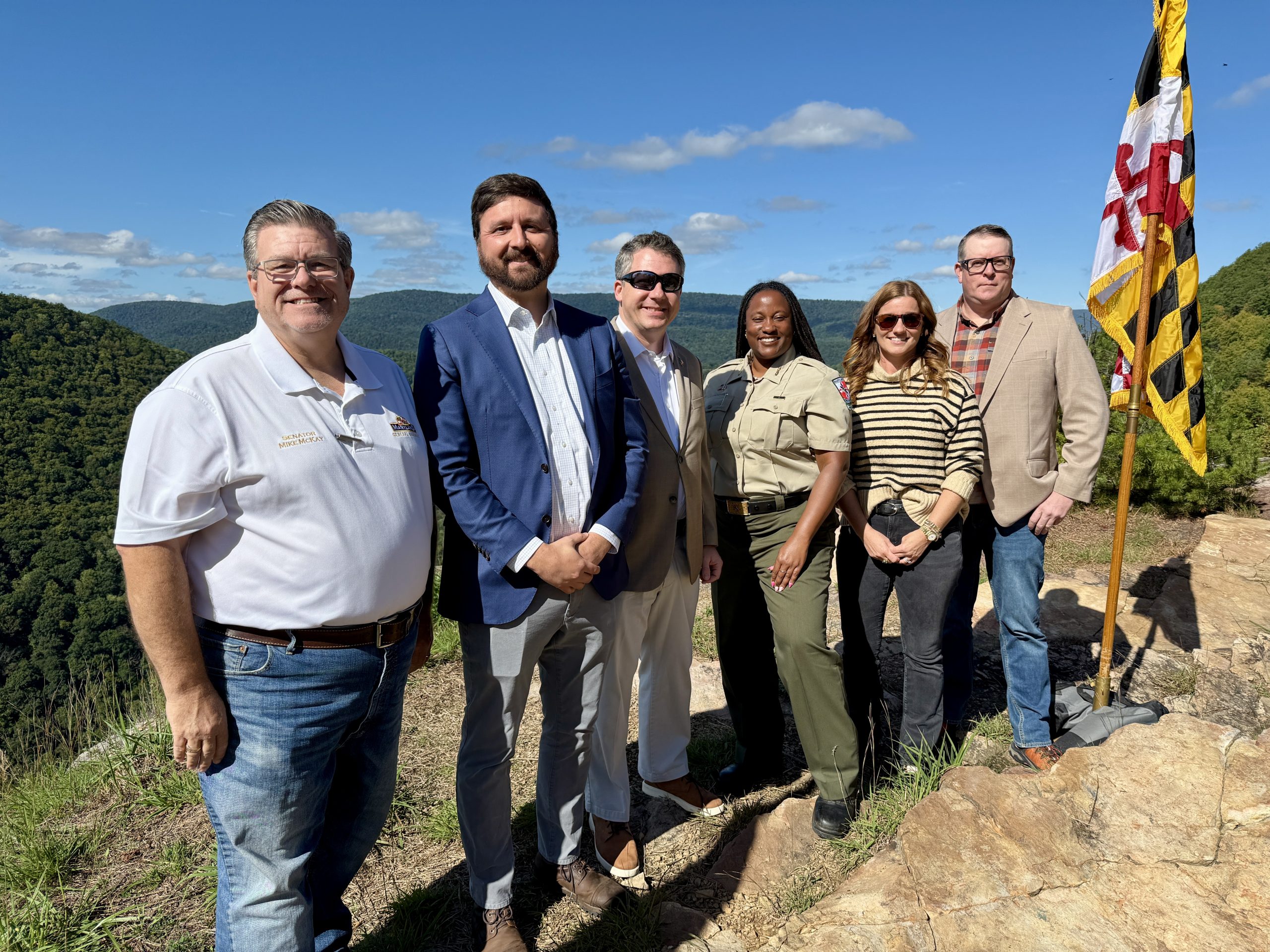
Maryland State Senator Mike McKay, DNR Secretary Josh Kurtz, DNR Capital Projects Director Eric Leudtke, Allegany Tourism Director Ashli Workman, and Frostburg University’s Jeff Simcoe at Wills Mountain State Park in Cumberland. Maryland DNR photo.
The Maryland Department of Natural Resources (DNR) announced grant funding through a partnership with Frostburg State University that advances the development and opening of Wills Mountain State Park in Allegany County.
The Appalachian Regional Commission (ARC), an economic development agency of the federal government and 13 state governments, recently approved a grant of $521,684 to Frostburg State University for the Wills Mountain State Park Comprehensive Planning Initiative project. With ARC’s investment, Frostburg State University, through its Frostburg Outdoor Recreation Economy Institute (FOREI), will work in partnership with DNR and the Maryland Park Service to complete the planning activities that will guide the development of Wills Mountain State Park for public access.
On Thursday, the department hosted a community gathering and stewardship celebration atop Wills Mountain in Cumberland to provide an update to local officials and other guests about the latest plans and funding for the park. The department also announced the purchase of an additional 195-acre forested property along the ridge and eastern slopes of Wills Mountain, which will be added to the park.

DNR Secretary Josh Kurtz delivers remarks during a progress update on top of the overlook at Wills Mountain State Park. Photo by AJ Metcalf, Maryland
“Wills Mountain State Park represents an important milestone in Maryland’s legacy of land protection and public access,” said Maryland DNR Secretary Josh Kurtz. “This mountain is a landscape of rare ecological significance, from its cliff communities to forest and migration corridors, to its historical significance. It also has significant potential in the future to attract tourists and adventurers who want to reach the mountaintop, gaze at the valley below, and then visit Cumberland’s shops, restaurants, and attractions.”
In addition to the ARC grant, the state is providing $200,500, and local sources are providing $31,500 to the planning effort, bringing the project total to $753,684.
“As a regional anchor institution, Frostburg State University is proud to support the Maryland Department of Natural Resources in advancing this important project for Allegany County and Western Maryland,” said Jennifer Walsh, Frostburg State University’s Senior Associate Vice President for Regional Engagement and Government Relations. “We are grateful to the Appalachian Regional Commission for this investment and its continued commitment to our region’s economic vitality, and we look forward to bringing FSU’s capacity and regional partnerships to this collaborative effort.”
The work funded by ARC will include a market analysis to understand visitor demand, a community visioning process to gather local input, an economic impact assessment to quantify potential benefits, and a concept-level master plan to guide future development.
“Comprehensive planning is an important first step toward informed decision making that balances conservation, public access, and economic development,” said Jeffrey Simcoe, Executive Director, Frostburg Outdoor Recreation Economy Institute (FOREI), Frostburg State University. “With the Maryland Department of Natural Resources leading the vision for Wills Mountain State Park, FOREI is ready to manage a planning process that puts conservation at its core while exploring the land’s history, outdoor recreation opportunities, and potential to support tourism and Mountain Maryland’s growing outdoor economy.”
DNR will also partner with Allegany County Tourism to develop the park’s plan, with an emphasis on outdoor recreation and local economic impacts.
“From a tourism perspective, what is especially exciting about Wills Mountain is that it gives people a completely new way to experience a place they may think they already know,” said Ashli Workman, Allegany County Director of Tourism. “From here, you can look off into the distance to the City of Cumberland, through the Narrows and across the surrounding mountains and see, all at once, so much of what defines this region.”
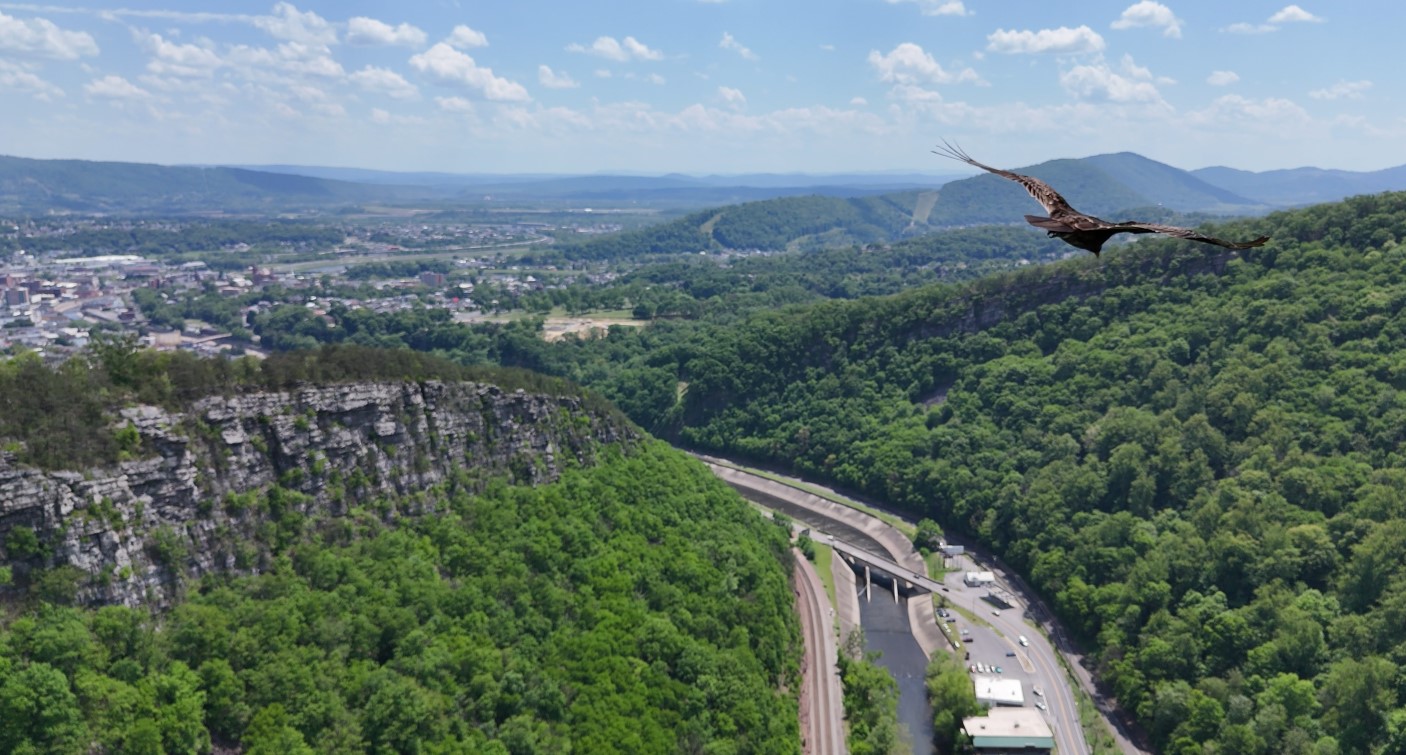
A birds-eye view from the top of Wills Mountain. Photo by AJ Metcalf, Maryland DNR
Preserving Wills Mountain for public use has been an effort 60 years in the making. The state purchased the first 51.69-acre parcel in 1966. Wills Mountain officially became a state park in 1998, when the Maryland Department of Natural Resources purchased about 305 of the current 823.38 acres.
Despite its designation as a state park, Wills Mountain has remained closed to the public for more than two decades because there has been no suitable location to construct an access road. The park is situated almost entirely along the mountain’s ridge and surrounded by private property.
To provide that access, DNR purchased the 48-acre site of the former Artmor Plastics plant in March 2024, adjacent to the park. The property includes an existing road up the mountain that, once repaired, will eventually enable the state to open Wills Mountain State Park to the public.
“For so many families, climbers, hikers, and residents of Allegany County, Wills Mountain is part of their personal and cultural history,” said Maryland Park Service Director Angela Crenshaw. “Today, we begin restoring that connection, carefully and deliberately.”
With a path toward public access now established, DNR is advancing the infrastructure improvements and resource protection efforts needed to prepare the park for visitors.
DNR’s Engineering and Construction team has taken steps to stabilize the road infrastructure to allow access for ongoing and upcoming planning and construction projects. DNR is working in partnership with the Maryland Environmental Service and the Maryland Department of the Environment to determine the extent of hazardous material remediation at the Artmor site. Once the necessary remediation is complete, DNR will begin demolition of the former plastics plant and develop the Artmor site to create parking and visitor services.
At the same time, protecting the mountain’s ecological resources remains central to the park’s development. DNR’s Wildlife and Heritage Service biologists have conducted extensive studies to document the plant and animal communities on the mountain and identify measures to protect their habitats. The sustainable management of Wills Mountain State Park will require carefully balancing public service and resource stewardship goals.
Wills Mountain is named after a prominent 18th-century Native American man named Will, and stands as a reminder that the story of westward expansion and early settlement rests upon much older Indigenous pathways. The park will also honor Shawnee and other Indigenous Peoples who used this area for movement, trade, and diplomacy and who continue to maintain relationships with the lands.
In the late 1800s and 1900s, the mountaintop was home to a hotel and tavern, then a textile plant, and most recently the Artmor Plastics plant that closed in 2013.
Wills Mountain State Park will be managed as part of the Rocky Gap State Park complex.
The Maryland Park Service continues to dedicate and celebrate new properties around the state as part of the Moore-Miller Administration’s work to expand access to public lands. Earlier this year, the Maryland Park Service accepted the donation of two acres of land, including a historic African-American cemetery at the Revolutionary War-era Catoctin Furnace, and added it to Cunningham Falls State Park. The department also celebrated the dedication of Freedman’s State Park in Montgomery County, which encompasses 1,000 acres of land once owned and farmed by a formerly enslaved family who were able to self-emancipate and whose descendants shaped the Civil Rights Movement in Maryland. In July, DNR hosted an acquisition acknowledgment ceremony for Wetipquin Creek State Park, a historic 445-acre property and plantation house that is Wicomico County’s first state park. Last month, DNR officially opened Savage Highlands State Park in Garrett County, which offers yurts, cabins, and rustic campsites for rent on land surrounded by the sprawling Savage River State Forest.
