

HabiChat article By Katy Gorsuch

Morning view of Full Moon setting by Lori Crisler, submitted to the 2023 Maryland DNR Photo Contest. Taken in early March, this was the Worm Moon.
Given the flair with which the Moon circles the Earth, it’s not at all strange that both humans and animals would become fascinated with it. In the past hundred years, certain folk names for the full moons have popped up in modern American culture, although many of them go back centuries. Recorded in English as far back as 1779 (and possibly even further back in French), Indigenous peoples of the Americas have named the full moons, often in alignment with animals responding to the changing seasons, or locally important events.
Full moon names varied widely depending on geographic location and language family amongst Native Americans, as wildlife responds differently depending on the length of the day i.e. there is less sunlight in Massachusetts in October than in Maryland on the same day. For example, in some locations one full moon might be named “Goose Moon,” while in another location the same time period could be the “Cold Moon.” The practice of naming moons this way doesn’t seem to have been historically universal, and in the centuries since it was first recorded by colonists, misinformation has proliferated. For our purposes, using supposed Algonquian full moon names as a starting point provides a wonderful opportunity for us to explore Maryland’s unique wildlife, and how the seasons change!
Winter Moons:
January_________________________________________________________
This moon is sometimes called the Wolf Moon, which may have European colonial origins.
Gray wolves (Canis lupus) were hunted to extinction in Maryland centuries ago; the closest wild canine today is the coyote (Canis latrans). Present in Maryland since 1972, Coyotes moved into new areas of North America following both the extirpation of the gray wolf as well as the thinning of deciduous forests across the East Coast. Prior to this, they were largely confined to western prairie, likely to avoid competition with wolves, who are noticeably larger. Coyotes in Maryland are larger than western coyotes, averaging about 30-40 pounds – about the size of a border collie.
Coyotes are closely related to the gray wolf, and occasionally hybridize with gray wolf subspecies. Observations of hybridizing go back to the 1930s and 1940s in the Great Lakes area, where coyotes colonizing former wolf ranges interbred with remaining wolf populations.

Coyotes running through the snow in West Virginia. Photo by ForestWander.com, CC BY-SA 3.0 US, via Wikimedia Commons
The species is highly adaptable, with urban coyotes in densely populated areas actually living longer than urban coyotes with more “natural” spaces, while still managing to avoid human contact.
Coyotes generally avoid humans, even when living in urban areas, but sometimes people will report being followed by a coyote, especially while walking their dogs. This behavior is called “escorting” and is most common when pups are growing; it is thought that this is parents checking up on potential threats to their young in their territory.
Midwinter finds coyote family packs forming. Coyotes may construct dens or clean out old dens of other species. They line their dens with dried grasses, and or the soft fur of the parents. It takes about 63 days for a litter to gestate, at which point an average of six pups are born. Unlike other canines, eastern coyote pups fight before they play; doing this is thought to help the pups establish an internal hierarchy, allowing them to relax into a more recreational environment.
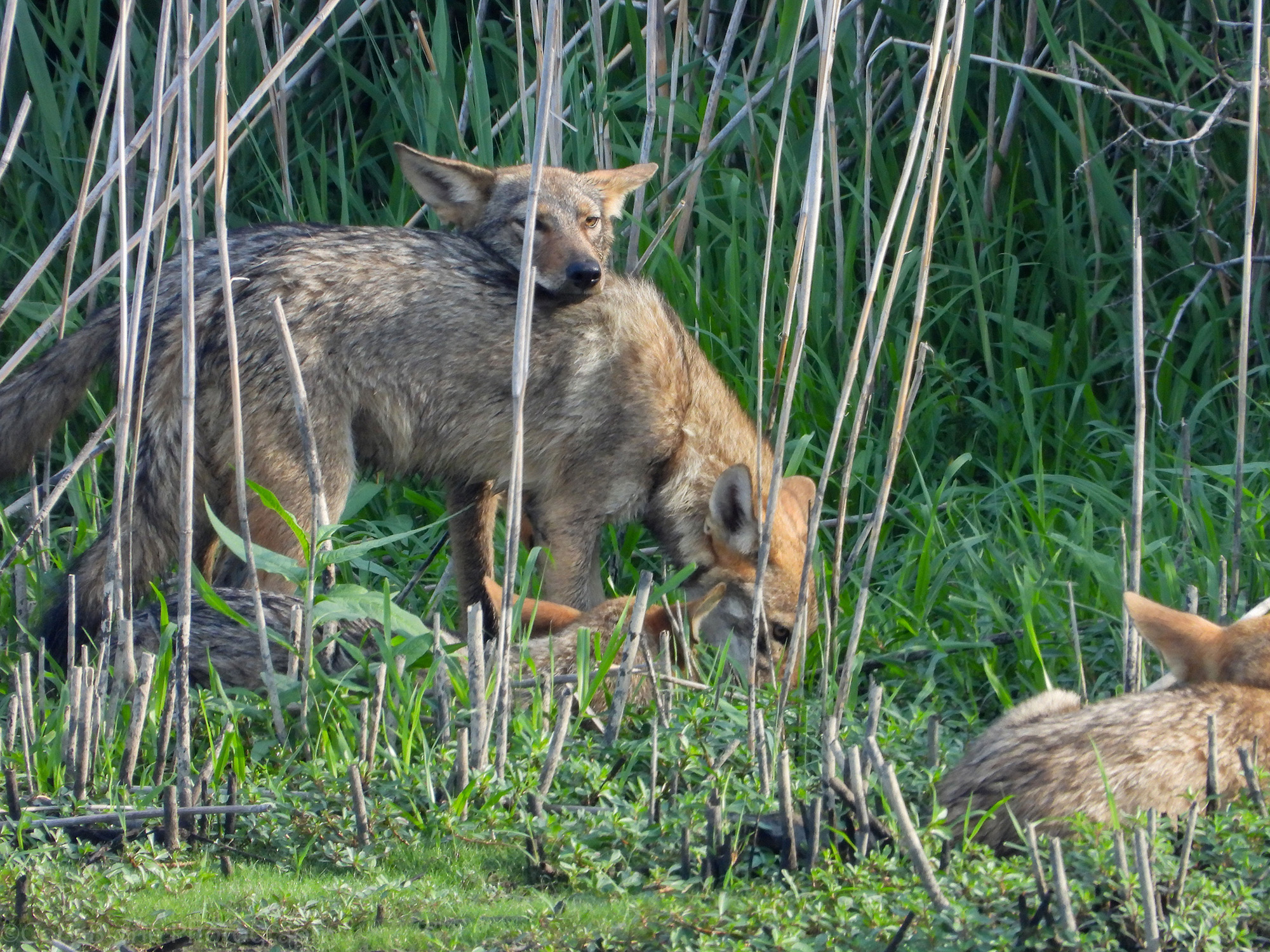
Coyotes in the wetlands of Hart-Miller Island, photo by Cory Byrne.
Perhaps we should call January’s Moon the Coyote Moon!
Suggested Coyote Moon Activities: make a den with couch pillows, chairs, blankets, and other soft materials. Try to see how well you can conceal the entrance to the “den.”
Practice coyote greetings! Coyotes are talkative! They have a wide range of different vocalizations, and the new year is always a good time to learn a new language.
Read more about Maryland’s Coyotes on the DNR website!
February_________________________________________________________
Writing in 1779, explorer Jonathan Carver cites this time period as the Snow Moon, for obvious reasons! Another name that may be Algonquian is Groundhog Moon.

Groundhog family holding a meeting by Abubakar Ringim, DNR Photo Contest 2023
Groundhogs, also called woodchucks, whistlepigs, marmots, and land beavers, (the list goes on) are the largest member of the squirrel family that lives in Maryland. Their species name “monax” comes from one of their Algonquian names, which translates to “digger.” Another Algonquian name, “wejack,” is likely where the name “woodchuck” originates. The name “whistlepig” comes from this sound groundhogs occasionally make as an alarm call.
You may notice that the Groundhog Moon, being in February, also generally coincides with Groundhog Day. This tradition was brought to America from Europe, except there it was a badger: “The badger peeps out of his hole on Candlemas Day (February 2), and, if he finds snow, walks abroad; but if he sees the sun shining he draws back into his hole.” This was written in the diary of Baltimore farmer Dickinson Gorsuch III in 1861, to whom the author of this article is almost certainly related.
Adult groundhogs eat up to a pound of vegetation a day, which can sometimes lead to unwanted interactions with gardeners. While we are used to watching bears fatten in the fall, groundhogs begin fattening up for winter in June, eating as much as they can to produce fat deposits they can use through hibernation. They are mostly herbivorous, occasionally eating insects, with the rare addition of bird eggs.
Suggested Groundhog Moon Activities: Make up a new tongue-twister for one of the other names of the groundhog! Many of us are familiar with the classic “How much wood would a woodchuck chuck if a woodchuck could chuck wood?” but the same attention hasn’t been given to the names whistlepig or groundhog! Coming up with a new one is a great way to pass some time and dig up some giggles.
Prepare a groundhog salad, using lettuce and raspberries to mimic their diet in the wild. Noodle-style croutons can easily substitute for grubs.
Learn more about groundhogs from the University of Maryland Extension website.
March___________________________________________________________
March has been referred to as either the Worm Moon or Goose Moon.
While in modern times people have come to associate this usage of the word “worm” with earthworms, historical texts point towards caterpillars and other larvae rather than earthworms.
Caterpillars serve as a food source for countless Maryland species; many of those that don’t become lunch instead become beautiful and interesting butterflies and moths as adults.

Yard Monster by Allan Nopfel, DNR Photo Contest 2013
Efforts have surged in recent years to support monarch butterflies in Maryland by planting native milkweeds, and in supporting native plants, we do the same for all the wildlife that calls our small but mighty state our home.
Suggested Worm Moon Activities: Plant or plan a Moon Garden!
Moon gardens are gardens with night-blooming flowers, or flowers that stay open all the time. When you use native plants in a moon garden, you provide important habitat for lesser-thought-of pollinators like moths, and have the added benefit of supporting Maryland’s native bats! Whippoorwills and other nightjars are also fans of moths as a prey source, and by planting host plants for native moths, you support these unique and beautiful nocturnal birds!If you’d like to turn your space into much-needed habitat, check out our Wild Acres resources.
