

Habichat article By Katy Gorsuch
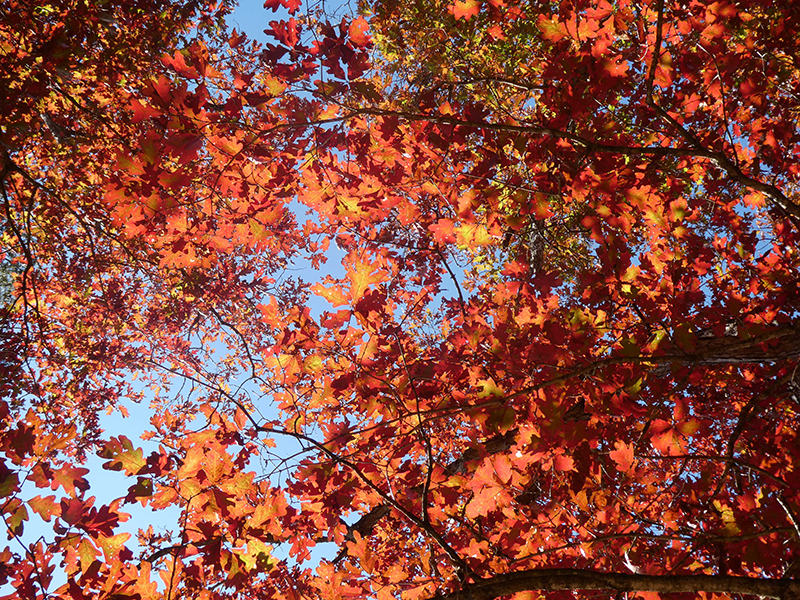
Quercus alba by Robert Severynse, submitted to 2021 Maryland DNR Photo Contest
What’s your favorite tree? If you’re any of Maryland’s thousands of native animals, your answer may be an oak!
Maryland boasts 22 species in the oak genus (Quercus), 21 of which are native. Maryland’s state tree is the white oak (Quercus alba), and from 1940 until 2002 an individual white oak tree known as the Wye Oak was the largest white oak in the country. The Wye Oak was declared the representative of the species in the state, serving in the position as a kind of mascot from 1939 until it fell due to old age and damage from a summer storm.
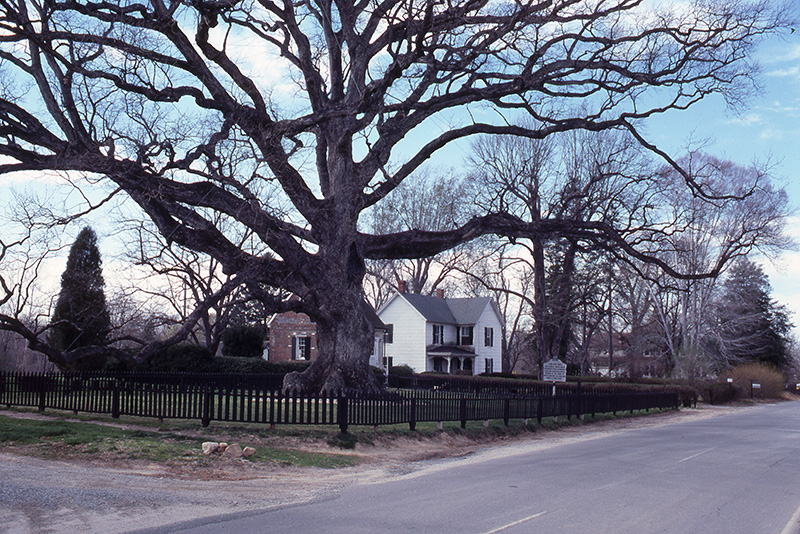
The Wye Oak in April 1977, taken by Maryland DNR Staff
The Wye Oak lived to be 500 years old, and that’s not unusual for an oak, which can have centuries long lifespans in the right circumstances. The Wye Oak’s reign was preceded by the death of the Mingo Oak, a white oak in West Virginia, who until 1938 was both the oldest and largest white oak in the world. The Mingo Oak’s age, verified by the Smithsonian Institution, was estimated to be roughly 580 years at the time of its death (a kind of obituary even appeared in The New York Times). Even this is not the longest living oak, as a handful of thousand-year-old oaks are still standing tall in Europe. In fact, clonal colonies of oaks may even live for thousands of years, as is the case for the Jurupa Oak in California, whose age is estimated at 13,000 years!
Oaks are diverse, with 500 global species in the same genus, and readily hybridize, meaning it can be difficult to identify an individual tree in areas where several species are present. Oaks are split into several groups for more easy categorization; red oaks (sometimes called black oaks) and white oaks are the most known groups, named after the color of the “heartwood.” The alternative name for red oaks comes from the generally darker color of the bark. The broad rule for telling the difference between these groups when bark-penetrating glasses are unavailable (always) is to look at the leaves; leaves with spiky ends tend to be in the red oak category, while rounded ends tend to be in the white oak category. White oak acorns tend to be wildlife’s preferred acorns, and they move on to red oak acorns if they aren’t available.
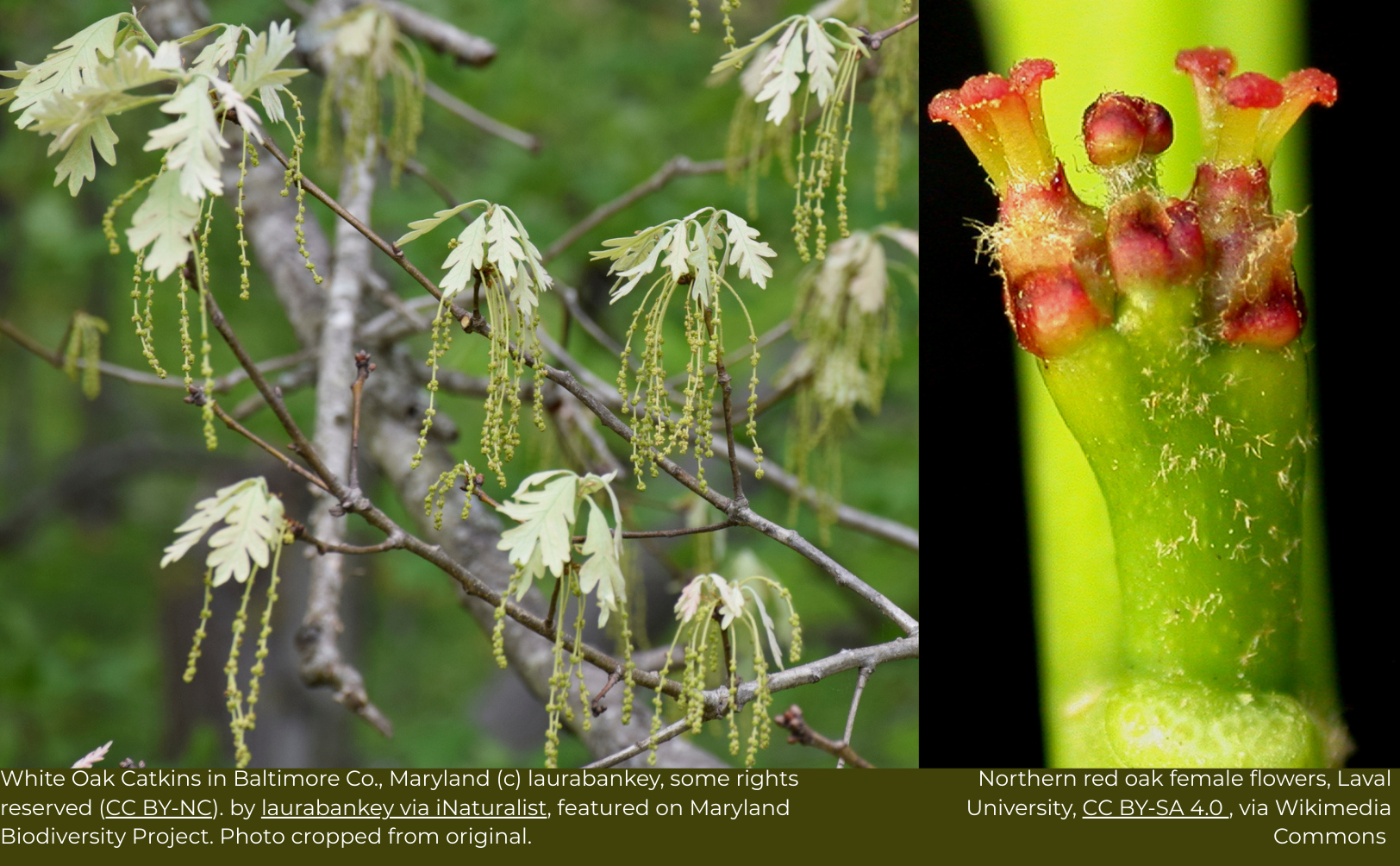
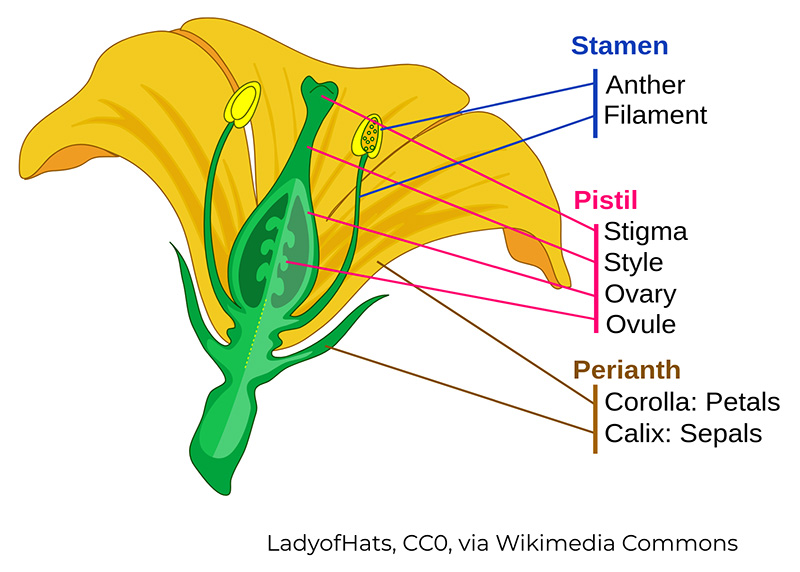
Flowers of oaks don’t take a form we traditionally recognize. When an oak blooms, it actually produces both “male” and “female” flowers. The “male” flowers are stamens that develop in clusters called catkins, from which pollen is distributed, while the “female” flowers are small pistils. In what we may think of as a garden flower (see diagram), these elements are typically included in the same location.
Oaks are wind-pollinated, and acorns develop from the pollinated flowers over varying lengths of time. An oak may self-pollinate, but female flowers are located higher in the tree to allow for more cross-pollination with other trees, and thus greater genetic diversity. Many oak species don’t produce acorns every year, and development can last anywhere from six months to two years in the case of red oaks. Most oaks don’t begin to produce acorns at all until about 20 years old, and northern red oaks may wait as long as 40 years. This feels like a long time on a human scale until you consider that humans mature similarly. Unlike humans, their overall lifespan is much longer, and an oak’s peak production doesn’t slow until 80 years or so of age! Even then, oaks continue to produce acorns, and the Wye Oak itself produced acorns into its old age and was even bearing a crop of acorns when it died at nearly 500 years old!
Many a small child (and inquisitive adult) has wondered why we as a species don’t make more use of these nuts, and the primary reason is the tannic acid they contain. Tannic acid is a tannin (although not all tannins are tannic acid), and is toxic to humans. Many animals possess the ability to process tannic acid, although cattle and horses do not and ingestion can be lethal. While tannic acid can be removed from acorns by leaching processes (and has been a common food in many cultures and places, including among European Neanderthals), other nuts may be preferable when available, since other food sources don’t require the same amount of work to eat. In North America, Eastern Woodland peoples used acorns as a staple food, along with other native nuts. For European colonists and their descendants, who didn’t have a tradition of acorn usage, a historically more available food source would have been the American chestnut, which until the early 1900s produced vast amounts of food (in 1914, the Virginia Dept of Agriculture estimated the year’s crop to be equivalent to approximately 2 million pounds of nuts). Interestingly, American chestnuts are actually cousins to oaks, as members of the Fagaceae family.

Oak Leaves and Acorns by Marta Fiscus, submitted to 2022 Maryland DNR Photo Contest
Acorns serve as a major food source for countless native animals, including wood ducks, rabbits, black bears, and even foxes! “Mast” is the term for fruit and nuts produced by wild plants, usually used in reference to animals eating them. One study found that 83% of an oak’s yearly crop is eaten by wildlife, with another 10% being unproductive or inert, and 6% being consumed by insects. This leaves less than 1% of an oak’s acorns to sprout! This may be why the genus has evolved to be so long lived, and why a large oak may produce up to 10,000 acorns some years.
Interestingly, oaks seem to have a plan to ensure some of their long-lived progeny make it past the hungry hoards; a “mast year” is a year when several species of oak drop acorns at the same time! It’s unclear how the trees in the area coordinate such an event, but plant communication is a diverse area of study and perhaps time will allow us to understand it. The benefit of mast years for the oak trees is that in the chaos of so much food, some acorns will make it through the season to nestle under the leaf litter, or be stored for later by a satisfied (but forgetful) squirrel or bird. If the trees were to drop a regular number of acorns every year, it may be harder for them to sprout, as local animals would come to rely on a certain amount of food being available for upcoming hibernation. Mast years generally occur every 2-5 years depending on the region; 2025 was a mast year in many areas of Maryland, potentially leading to a lower bear harvest than in previous years, as bears don’t roam as widely for food if acorns are available.
Perhaps the most impressive thing about oaks is their role as keystone species in their communities. Native oaks support 950 caterpillar species nationwide, which themselves serve as the base of spring bird feeding, especially of baby birds! 96% of terrestrial bird species in North America feed insects to their young; growing is serious business, and baby birds need the protein provided by insects to grow as quickly as they do. Beyond that, moths and butterflies are notable pollinators, and serve as food for other animals, including bats!
With their fortitude, longevity, and adaptability, it’s no wonder that oaks have made their way into folklore around the world. We’ve mentioned before ancient Greek divination by listening to the rustling of the leaves of a sacred oak, but that’s just scratching the surface of their deep mythological roots. Historically, oaks have often been associated with thunder gods like Thor and Zeus, and a glimpse into natural history may show us why: oaks may be the tree most hit by lightning! While this isn’t conclusive, where this happens it’s likely due to their comparative height, although other factors that may play a role are the resin content of the tree, and bark texture. Trees are more conductive than the air, but certain trees (like conifers) have greater resistance to the flow of electricity, and so might suffer more immediate and visible damage.
This spring, if you have the space, plant a native oak to support your local ecological community! DNR’s Forestry Service’s nursery offers saplings of five native oak species for order (all but the sawtooth oaks), in increments of 25. If that number seems too big, consider splitting them with neighbors, friends, or coworkers to distribute saplings to spaces that need wildlife habitat!
Remember: community takes cooperation, and as Ralph Waldo Emerson said, “the creation of a thousand forests is in one acorn.”
Visit the Maryland DNR website for more about creating a wild backyard with native Maryland trees and ha recommended tree list.
If you’d like to read more about oaks’ role as the base of many ecosystems, The Nature of Oaks by Doug Tallamy is a great resource, as is the USDA Field Guide to Native Oak Species.
