

Pilot project will guide development of a restoration plan at an exciting period for mussel efforts in the state
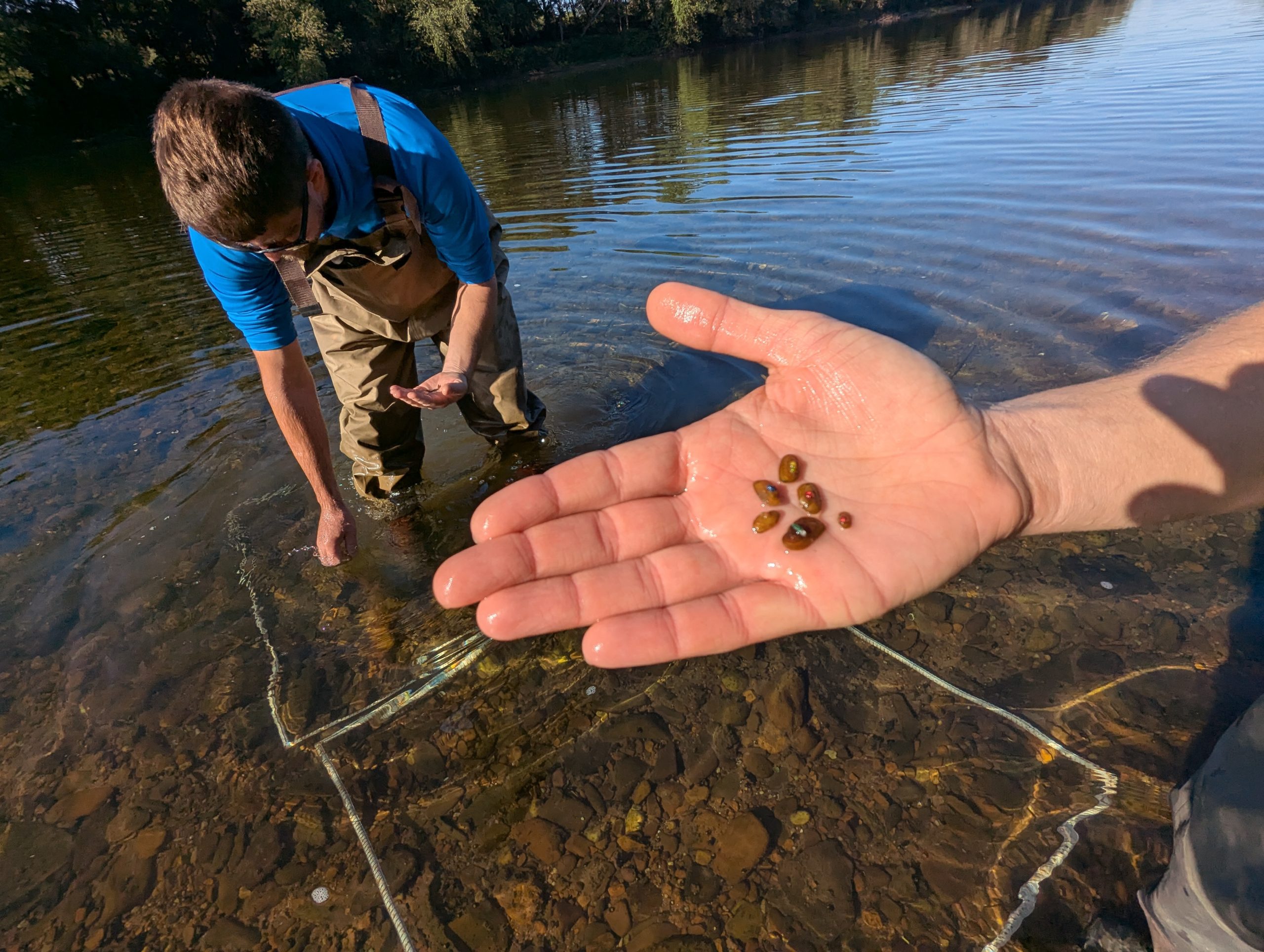
Maryland DNR biologist Matt Ashton hold several eastern elliptio mussels, as natural resources technician Mike Dhillon places mussels in quadrants as part of a pilot restoration project. Photo by Joe Zimmermann/Maryland DNR
On a chilly fall morning, as fog drifted over the Potomac River, scientists with the Maryland Department of Natural Resources hauled three concrete balls out of the water.
Inside each of these 25-pound, thick-walled bowls was a chamber where several small shells sat atop a wire mesh—a group of year-old freshwater mussels. Their concrete shelters, or silos, allowed the juvenile eastern elliptio mussels to grow undisturbed, consuming suspended particles carried by the river. Of 368 mussels placed in the silos for the summer, 358 survived.
“That’s rock solid,” Matt Ashton, a DNR mussel biologist, said of the survival rate. “We can say across the entire area we studied, there was nothing affecting survival this summer.”
After measuring the mussels, Ashton and his team waded back into the Potomac and carefully placed each bivalve back into the riverbed, making a divot with a finger in the soft bottom and planting the shell in the sediment. The next test for the mussels would be surviving the winter in the river on their own, without the protection of the silos.
These diminutive mollusks, most of them smaller than a fingernail, could contribute to the next decade of mussel restoration in the state. The silos are part of a pilot project that will guide DNR’s development of a large-scale mussel restoration plan for the upper Potomac River, with the goal to bring back species that are as important for water quality in freshwater as oysters are for saltwater.
In Maryland and in much of the world, mussels here have undergone severe declines due to habitat loss, pollution, and other factors. Freshwater mussels are the most imperiled animal group in North America, and 14 of Maryland’s 16 species of mussels are rare, threatened, or endangered.
Still in its early stages, the pilot project shows where mussels could survive, and where the Department of Natural Resources can direct future restoration.
“We’re at the beginning of an exciting time for freshwater mussel restoration in Maryland,” DNR Secretary Josh Kurtz said. “Historically, mussels have dwindled in number throughout the region. Now we are actively expanding efforts to bring mussel populations back because we know how important mussels are for providing clean water and increasing biodiversity.”
Aside from the value of protecting these individual species, this type of restoration could provide a wide range of ecosystem benefits. Mussels provide food for many animals, from fish to otters, as well as habitat for macroinvertebrates. But most importantly, every mussel is filtering algae, nutrients and sediment from the water column. More mussels ultimately means a cleaner river, Ashton said.
“Several million people get their drinking water from the Potomac River down near Washington, D.C,” Ashton said. “A lot of that water starts in the headwaters—it’s currently not being filtered by several million mussels on its way downstream. So if you value clean drinking water and recreational activities on the water, you should probably value what freshwater mussels do to that water before it gets to you.”

Mike Dhillon, Megan Kubala, and Matt Ashton place mussels in the upper Potomac River, with the Sideling Hill road cut visible as a dip in the horizon in the distance. Photo by Joe Zimmermann/DNR
New horizon
The project comes as Maryland is setting off on a new era for mussel restoration. The revised Chesapeake Bay Watershed Agreement, which Bay state leaders are expected to adopt in early December, lays out goals for mussel restoration, calling out states to “develop comprehensive freshwater mussel restoration plans for 10 tributaries and implement key recommendations from at least five of these plans by 2040.”
And in October’s Water Quality Certification for the Conowingo Dam issued by the Maryland Department of the Environment, Constellation Energy committed to pay Maryland $23 million to help support the construction, operation, and maintenance of a mussel hatchery that will restore mussel populations in the Susquehanna River upstream of the dam. That funding is pending final issuance of a Federal Energy Regulatory Commission license.
“When you hold one of these tiny mussels in your hand, you’re holding a natural water-cleaning machine—a partner in our fight for a healthier Bay,” Maryland Secretary of Environment Serena McIlwain said. “Our 50-year agreement on the Conowingo Dam includes funding to build a hatchery that will bring millions of these quiet heroes back to the Susquehanna. This is what restoration looks like in real time: science, collaboration, and a deep belief that when we give nature a chance, it always shows us what’s possible.”
The restoration projects on the Potomac and Susquehanna rivers are separate and supported by separate funding, but DNR’s existing mussel hatchery is already ramping up production.
Anna Dellapenta, who came on as DNR’s mussel hatchery manager in April, introduced methods she developed at Virginia Tech, raising mussels on pond water and copious amounts of commercial algae.
This year, she said, the hatchery produced just under 75,000 mussels—nearly 10 times higher than the hatchery’s 2024 output.
“We’ve had tremendous success so far,” Dellapenta said. “We were pretty happy with those numbers.”
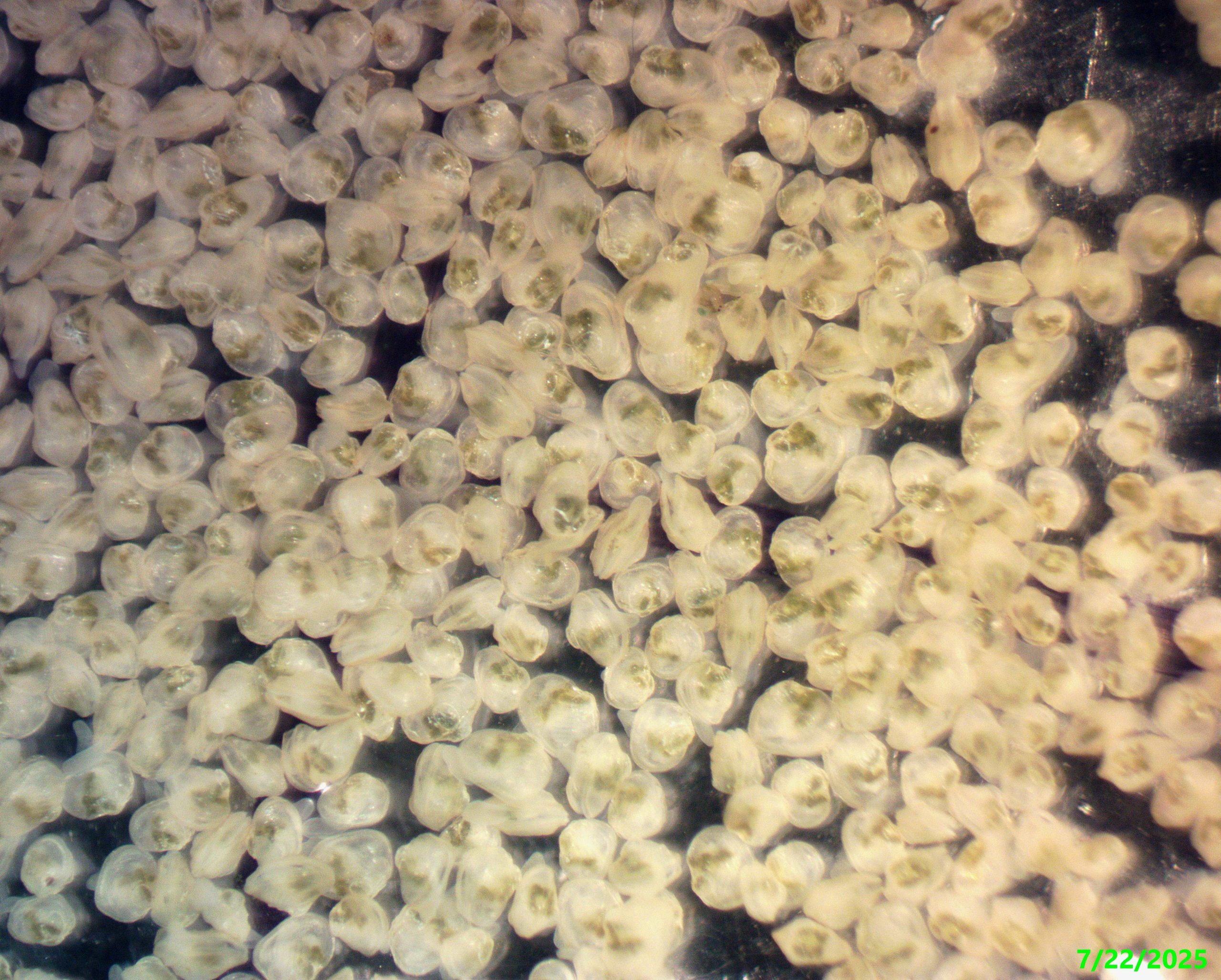
Juvenile yellow lampmussels, under a microscope, raised at the DNR hatchery. Photo by Anna Dellapenta/DNR
The operation uses space in the Joseph Manning Hatchery, one of the department’s major fish hatcheries in Brandywine. The department plans to build the new mussel hatchery at the same location, with construction set to begin in 2028.
The mussel hatchery also takes advantage of the fish raised at the Manning hatchery. Early in their life cycle, freshwater mussels go through a stage where they depend on fish to grow. Mussel larvae, known as glochidia, attach to the gills of fish to access nutrients and avoid predators as they develop. When done properly at the hatchery, this process doesn’t harm the fish. After juvenile mussels drop off their gills, the fish can return to Manning’s holding tanks, later to be stocked with their peers in bodies of water across Maryland.
Ashton and other scientists gather mussels in nearby rivers and bring them to the hatchery, where Dellapenta and her technician Dorothea Mildenberger facilitate their reproduction and raise the mussels until they’re old enough to be returned to the water. Additional mussel rearing is performed at the department’s mobile mussel lab in Susquehanna State Park.
With the field of mussel restoration still relatively new, nearby states often work together. The mussels for the Potomac pilot project came from the Harrison Lake National Fish Hatchery in Virginia, while many of the lampmussels produced in Maryland’s hatchery will support restoration efforts in Pennsylvania. Dellapenta is culturing about 8,000 more juvenile eastern elliptios produced at Harrison Lake to be stocked next year.
“There’s a lot of sharing of information, a lot of collaboration and partnerships,” Dellapenta said. “It’s a nice, tight-knit community.”
As she looks to scale up, Dellapenta said she’s also looking closely at Maryland’s other filter-feeding bivalve shellfish that has been the focus of intense restoration: oysters. These saltwater relatives of mussels are produced in the billions at Maryland hatcheries, and the state recently completed a historic restoration project by restoring oysters to five rivers that flow into the Chesapeake Bay by converting 1,300 acres into productive oyster habitat. During the time of the restoration projects, overall oyster populations more than tripled in Maryland’s portion of the Bay.
While oysters and mussels differ in some of their needs and lifecycle stages, the two mollusks have a fair amount of commonalities in how they are raised, and Dellapenta said the DNR mussel hatchery’s proximity to these oyster hatcheries makes it uniquely situated to learn lessons from their successful operations.
Meanwhile, the mussels at the hatchery are spending their winter in outdoor ponds at the site. Still only about 2 millimeters long, the mussels are old enough to face the season in the protection of floating bushel baskets. Next year, Dellapenta will gather the thousands of mussels from the pond and ready them for the next stage of restoration.
Cleaner waters
For the last day of the season’s work on the Potomac River project, Ashton and his team spent the rest of the morning placing the silo mussels at several other sites in the river upstream of Potomac Dam Number 5, west of Hagerstown.
The brown shells of the mussels they placed sported one bright dab of color—spots of glitter that the scientists superglued to the shells’ surfaces. The mussels from each of the 10 silo sites got a different color, and then the mussels were randomized for where they would be placed in the river. The glitter helps the scientists differentiate between mussels that initially grew at different sites and from wild mussels.
With their small size, muted coloring, and preference for burying themselves in the substrate, mussels can sometimes be hard to spot under the moving current. Ashton’s team also glued radio tags on one out of every 10 eastern elliptios, to aid in recovering them next year with a special underwater antenna.
“You can find them,” Ashton said. “You just have to go very slow.”
As part of their work, Ashton’s team also surveys for the presence of mussels, snorkeling through rivers and streams and scrutinizing the bottom for the hint of a shell or the fluttering gills of a mussel. Mussels tend to be understudied, Ashton said. Undesirable as a food product and with little direct commercial value, freshwater mussels historically tended to pass generation after generation without attracting much attention from people. Even Maryland DNR did not start collecting data on freshwater mussels until 1990. At some streams Ashton and his team visit, he said their surveys mark the first data ever collected on mussels at that site.
This lack of data is furthered by the mussel’s disappearance from the landscape. Sensitive to changes in water quality and habitat, mussels are relegated to cleaner waterways, often in areas with more forest cover—the presence of mussels is a good indicator of a healthy stream.
And mussels started to decline a long time ago, even before large-scale industrialization. The building of dams since the colonial period has impacted mussels, since the dams block the passage of migrating fish, such as American eels, that mussels rely on. The pollution and habitat loss from mining and logging only furthered that downturn, and now scientists can only estimate what mussel populations might have been based on the capacity of mussels that a waterway could support. The effects from those historical impacts have largely been mitigated through dedicated restoration efforts and the health of rivers in the region are recovering.
The Potomac project is supported by funding from the Maryland Senate and the National Fish and Wildlife Foundation. About $185,000 of a fiscal year 2024 Maryland Senate appropriation was used to secure a NFWF Central Appalachia Habitat Stewardship Program grant of $273,682, which was provided by the Chesapeake Bay Program, to fund the restoration plan.
The next phase of the pilot project will involve more monitoring of this year’s silo mussels and the placing of more tagged mussels into additional plots, as well as analyzing data collected on water quality. Taken together, these data points will help the department draft the restoration plan for the upper Potomac, which will determine what large-scale restoration there could look like.
“When we put all the pieces of this project together, it gives us pretty good confidence that the river should be able to support more mussels than there are, where the habitat is suitable,” Ashton said. “It doesn’t because of things that happened long in the past, and they can’t recolonize on their own. But the habitat in the upper river should be able to support millions of mussels.”
By Joe Zimmermann, science writer with the Maryland Department of Natural Resources
